
Average Real Estate Commission Rates 2026 — Flat Fee vs Commission Compared

Last updated March 17, 2026 Here’s what nobody in real estate wants you to do: the math. On a $400,000 home, the standard commission — still hovering between 5.44% and 5.70% depending on who you ask — works out to roughly $22,000. That’s a new car. That’s a year of childcare. And it comes straight out of your equity at closing, whether your agent spent 200 hours marketing your home or 20. The flat fee alternative? As little as $95 upfront for the same MLS exposure. That gap is why we wrote this guide — and why we update it every time the data shifts. Since the NAR settlement took effect in August 2024, commission structures have changed in theory. In practice, rates have barely moved (and may have actually increased slightly on the buyer’s side). What has changed is that sellers now have more room to choose how they pay — and flat fee services like HomeRise have filled that space. If you’re selling in 2026, this is the decision that will affect your bottom line more than almost anything else. In This Guide Average Real Estate Commission in 2026 Quick Comparison: Flat Fee vs Commission How Flat Fee Real Estate Actually Works How Commission-Based Real Estate Works 2026 Cost Comparison by Region and Home Value HomeRise vs Zillow, Redfin, and Other Options Which Sellers Benefit Most from Each Model Real 2026 Case Studies and Savings Questions to Ask Before You Choose FAQs What Is the Average Real Estate Commission in 2026? The short answer: somewhere between 5.44% and 5.70% combined, depending on the source. A February 2026 survey by Clever Real Estate, covering 533 agents, put the national average at 5.70% — broken down as 2.88% for the listing agent and 2.82% for the buyer’s agent. Other sources, including NAR-derived data, put the combined average closer to 5.44%, with a 2.77% / 2.67% split. Here’s what that actually costs at different price points: Home Price At 5.44% Commission At 5.70% Commission Flat Fee (HomeRise Essentials) $300,000 $16,320 $17,100 $95 + settlement fee $400,000 $21,760 $22,800 $95 + settlement fee $500,000 $27,200 $28,500 $95 + settlement fee $750,000 $40,800 $42,750 $95 + settlement fee The thing that jumps out isn’t the difference between 5.44% and 5.70%. It’s the difference between any percentage and a flat fee. At $500K, you’re looking at $27,000+ in commissions versus under $600. And yes — with a flat fee MLS listing, your home still goes on the MLS, Zillow, Realtor.com, and every other major listing site. The exposure is identical. Commission rates by state vary more than most people realize. Michigan sits at the high end, averaging around 6.03%. States like California tend to run lower (around 5.03%), partly because higher home values make the dollar amounts so large that agents are more willing to negotiate. If you’re in a high-commission state, the savings from going flat fee are even more dramatic. One more thing worth noting: after the NAR settlement, buyer’s agent commission actually rebounded. It dropped briefly from about 2.6% to 2.5% in late 2024, then climbed back to 2.82% by early 2026. The settlement gave sellers more flexibility in how they structure buyer agent compensation, but it didn’t trigger the fee compression a lot of people expected. Quick Comparison: Flat Fee vs Commission Models Feature Traditional Commission Model Flat Fee Model (HomeRise) Listing Agent Cost 2.5%–3% of the sale price. The more your home sells for, the more you pay. One set fee ($95–$495 upfront), or 1% at closing for full service. Same cost regardless of sale price. Buyer’s Agent Cost Typically 2.5%–3%. Standard expectation. You choose the commission to offer — typically 2%–3% to stay competitive. Equity Logic Penalizes growth. Higher property value = higher fee. Protects equity. If your home sells $50K over ask, you keep that $50K. MLS & Online Exposure MLS listing, Zillow, Realtor.com, Trulia syndication. Identical. Same MLS listing and syndication to every major site. Services Full service — signage, lockbox, showings, negotiation, paperwork. Ranges from DIY with MLS access to full service with a local expert at 1%. Transparency Fees are a percentage buried in the closing statement. Clear, upfront pricing. You know the cost before you list. How Flat Fee Real Estate Actually Works Flat fee real estate gives sellers access to the MLS — the database that feeds listings to about 80% of active buyers — without paying a percentage of their sale price for the privilege. You pay a set amount. Your home gets listed. Buyers and their agents find you the same way they’d find any other listing. That’s really all there is to it at the basic level. The difference between flat fee providers is how much support you get beyond the listing itself. At HomeRise, there are three tiers: Essentials ($95 + settlement fee): MLS listing and syndication. You run the sale. Best for experienced sellers and investors who’ve done this before and don’t need hand-holding. Advanced ($495 + settlement fee): Everything in Essentials, plus more tools and guidance along the way. Full Service (1% at closing): A licensed local expert handles pricing, showings, negotiation, and paperwork. It’s a real agent experience at a third of the cost. A real example: Chris Driver listed his Charlottesville, VA home through HomeRise and had an accepted offer in two days. He saved the entire 3% listing fee. His advice? “Take really good quality pictures of your home and put together a warm, inviting, detailed home description. Go get a $20 lock box, and be cool with paying a fee for the buyer agent. You’ll save the entire listing fee of 3%.” That’s the flat fee approach in practice — you trade some DIY effort for thousands in savings. And if things get complicated mid-sale, you can upgrade your package without starting over. How Commission-Based Real Estate Works Commission-based agents charge 2.5% to 3% of the sale price, collected at closing. You also typically offer a similar percentage to the buyer’s
Flat Fee vs Commission: The 2026 Home Seller’s Guide to Real Estate Costs
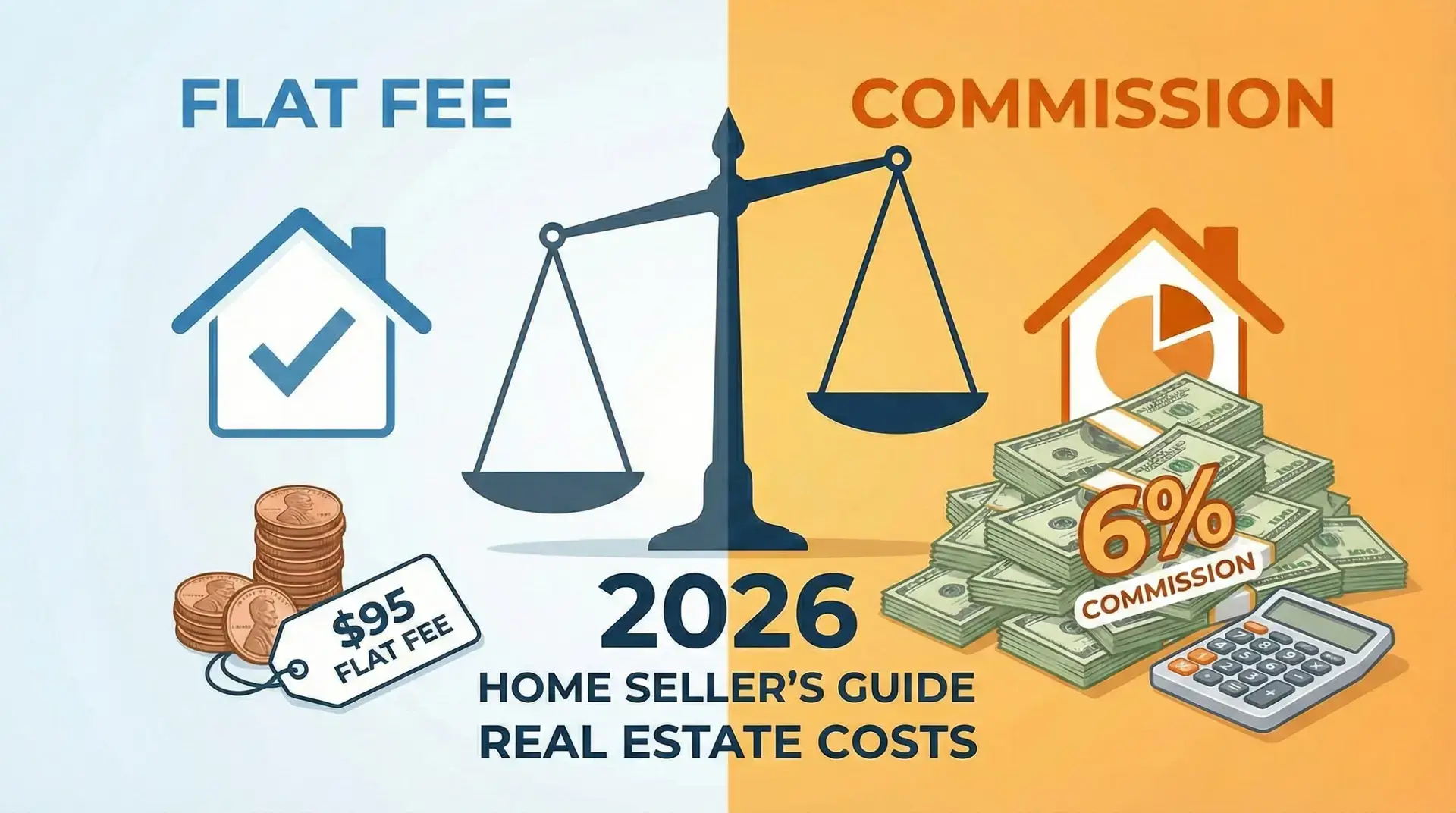
Flat Fee vs Commission Real Estate In 2026, U.S. home sellers face a pivotal choice: stick with traditional commission-based real estate agents or leverage a flat fee model to save thousands. With the National Association of Realtors’ (NAR) settlement taking effect in August 2024, the average combined commission for buyer’s and seller’s agents now hovers around 5.44% nationwide. For a $400,000 home, that’s roughly $22,000 in fees. But alternatives like flat fee services-charging as little as $100 to $1,000 upfront-are gaining ground, offering the promise of savings from $7,000 to $30,000 or more per sale. These changes matter tremendously for homeowners, especially those considering For Sale By Owner (FSBO) or seeking more control over their sale. This guide delivers a clear, data-driven comparison of flat fee and commission models, answers core seller questions, and demonstrates how HomeRise empowers sellers with transparent pricing, regional data, and real-world expertise. Introduction: Selling Your Home in 2026 Selling a home in 2026 is fundamentally different than just a year ago. The NAR settlement, enacted in August 2024, transformed commission structures and negotiation norms, giving sellers more leverage to choose the model that best suits their needs. Today, the average combined commission rate for U.S. home sales stands at 5.44%, but sellers are no longer locked into this system. Flat-fee real estate services have emerged as a competitive alternative, promising significant cost savings and greater transparency. For many, the choice between a flat fee and a traditional commission model is the single most important financial decision in the home-selling process. Experienced sellers now weigh not just commission rates, but also control, exposure, and the level of professional support needed to maximize their proceeds. According to recent market data, sellers can negotiate lower rates, explore flat-fee alternatives, or opt for discount brokers, making it crucial to understand the financial and practical trade-offs involved. Quick Comparison Table: Flat Fee vs Commission Models Feature Flat Fee Listing Traditional Commission Cost to Seller One-time fixed rate (e.g., $99–$499). You keep the entire listing commission savings. Percentage of Sale Price (typically 2.5%–3% for listing side). Fees scale up as your home value rises. Market Exposure Full Exposure. Listed on the local MLS plus syndication to Zillow, Realtor.com, Redfin, and Trulia. Full Exposure. Listed on the local MLS plus syndication to Zillow, Realtor.com, Redfin, and Trulia. Contract Terms Flexible. Often month-to-month or until sold. You retain the right to sell on your own (FSBO) with no penalty. Restrictive. Usually requires a 6–12 month exclusive contract. You pay the commission even if you find the buyer yourself. Buyer Inquiries Direct Connection. Leads and calls are routed directly to you, allowing you to answer questions and vet buyers instantly. Filtered. The agent acts as a gatekeeper, filtering calls and scheduling showings based on their availability. Negotiation Style You Control the Deal. You negotiate price and terms directly, or hire hourly support only if needed. Agent Represented. The agent negotiates on your behalf, acting as a buffer between you and the buyer. Payment Structure Pay for What You Use. A la carte pricing means you don’t subsidize marketing costs for other clients. Bundled Service. You pay a high premium that covers the agent’s overhead, marketing for other homes, and office fees. Equity Retained Maximum. You save thousands of dollars at closing, protecting your hard-earned equity. Reduced. A significant portion of your equity is deducted at closing to cover listing fees. Flat Fee vs Commission: Definitions and Industry Overview The core difference between flat-fee and commission-based real estate models lies in their payment structures. Flat fee services charge a predetermined amount, usually between $100 and $1,000-for listing your property on the MLS, America’s largest database of homes for sale. You pay this fee upfront, often gaining direct control over pricing, showing schedules, negotiations, and more. By contrast, traditional commission-based services require you to pay a percentage of your home’s final sale price, typically split between the listing agent and the buyer’s agent. In 2026, the national average commission stands at 5.44%, but the listing side averages 2.77% and the buyer’s side 2.67%. This means that for a $500,000 sale, you could pay approximately $27,200 in commissions under the traditional model. Flat fee models are especially attractive to experienced or cost-conscious sellers, while commission-based agents often appeal to first-time sellers seeking comprehensive support. How Flat Fee Real Estate Works (with HomeRise examples) Flat fee real estate services offer sellers access to the MLS-a critical step for reaching 80% of buyers-without the burden of a high commission. HomeRise, for example, provides three distinct packages: Essentials ($95 plus a small settlement fee), Advanced ($495 plus settlement fee), and Full Service (1-2% success fee payable at closing). Sellers can choose the level of support they need, from simple MLS access to full local expert guidance. A real-world example: Chris Driver listed his Charlottesville, VA home with HomeRise and was under contract within 2 days, saving the full 3% listing fee. His advice: “Take really good quality pictures of your home and put together a warm, inviting, detailed home description. Go get a $20 lock box, and be cool with paying a fee for the buyer agent. You’ll save the entire listing fee of 3%.” Flexible service levels and transparent pricing are key advantages, allowing sellers with confidence and experience to maximize their profit while still having expert help on standby if needed. How Commission-Based Real Estate Works Commission-based real estate agents operate on a percentage of the sale price, paid only at closing. The standard split in 2026 is roughly 2.77% to the listing agent and 2.67% to the buyer’s agent. This approach bundles comprehensive marketing, professional photography, open houses, negotiations, contract management, and compliance with disclosure requirements. Agents conduct market analyses to price homes competitively and use their networks to attract qualified buyers. For first-time sellers or those in complex markets, this hands-off approach can reduce legal and logistical risk. According to current statistics, homes sold with agent support net $50,000 more on average than those sold
FSBO vs Flat Fee MLS Listing: What’s the Difference?

FSBO vs Flat Fee MLS If you’re considering listing your home For Sale By Owner (FSBO), you recognize the potential for significant savings on real estate commissions and you’re preparing to take control. However, navigating the FSBO vs Flat Fee MLS landscape can be confusing. You may be wondering what costs and services are associated with a Flat Fee Realtor versus a pure Flat Fee MLS Listing. Are they the same? Which one will effectively provide the critical exposure your home needs? Understanding the nuances of the FSBO vs Flat Fee MLS decision is essential. Making the wrong choice could impact your selling experience, the level of control you retain, and ultimately your potential savings. Read on to clarify these options so you can win the FSBO vs Flat Fee MLS debate and choose the best route for your home-selling journey. What is a Flat Fee MLS Listing? At its simplest, a Flat Fee MLS Listing has you pay a single, flat fee to have your property listed on your local Multiple Listing Service (MLS). The MLS is the primary tool used by real estate agents to locate properties for buyers, significantly boosting your home’s visibility. When analyzing FSBO vs Flat Fee MLS, the primary advantage of the MLS option is cost-effective access to buyers without paying a full realtor commission. Your property gains exposure to a broad network of agents, far beyond what a “For Sale” sign or a basic FSBO website can achieve. However, this service typically caters to hands-on sellers. While the service provider handles the MLS listing, you’ll manage nearly everything else, including: Pricing your home accurately Handling inquiries and scheduling showings Negotiating offers directly Managing paperwork and closing details This option suits sellers confident in managing their sale independently. It is often the deciding factor in the FSBO vs Flat Fee MLS choice for those who want essential market visibility while maintaining full control and maximizing savings. What is a Flat Fee Realtor? The term “Flat Fee Realtor” is slightly more complex. Unlike a simple Flat Fee MLS listing, a Flat Fee Realtor involves hiring a licensed agent or brokerage that charges a flat fee rather than a percentage-based commission. This brings a new layer to the FSBO vs Flat Fee MLS comparison. The critical distinction lies in the scope of services provided. Some may offer services comparable to traditional agents, while others might only provide basic guidance alongside your MLS listing. Typical services from a Flat Fee Realtor may include: MLS listing entry Professional pricing advice Negotiation support Assistance with closing paperwork Given this variability, it’s crucial to clearly understand exactly what’s included. In the context of FSBO vs Flat Fee MLS, a Flat Fee Realtor bridges the gap between going it alone and hiring a full-service agent. FSBO vs Flat Fee MLS: Key Differences at a Glance Here’s a quick comparison to help you weigh your options in the FSBO vs Flat Fee MLS market: Feature Flat Fee MLS Flat Fee Realtor Service Level MLS access only; requires complete seller involvement. MLS access + varying levels of professional assistance. Control Maximum seller control. Professional guidance reduces workload but reduces control. Cost Most affordable ($). Higher flat fee ($$), but cheaper than commission. Ideal Seller Confident, hands-on FSBOs. Sellers wanting support while saving money. Pros & Cons of Flat Fee MLS for FSBOs Pros: Cost-effective exposure: The most affordable way to get on the MLS. Complete control: You manage the process, showing schedule, and strategy. Maximum savings: Retain the most equity possible, a key win in the FSBO vs Flat Fee MLS evaluation. Cons: Hands-on involvement: Requires time and effort to manage. Learning curve: Can feel overwhelming without real estate experience. No representation: You handle your own negotiations and legal paperwork. Pros & Cons of Flat Fee Realtors for FSBOs Pros: Professional guidance: Expert advice is available when you need it. Reduced workload: An agent handles some of the heavy lifting. Comfort level: Easier to deal with buyer agents when you have representation. Cons: Higher Cost: Typically more expensive than a simple MLS-only listing. Less control: You may have to defer to the agent’s strategy. Variable service: “Flat fee” can mean different things to different brokerages. How to Choose the Best Option for Your FSBO Needs Choosing your path in the FSBO vs Flat Fee MLS landscape depends on your comfort level, experience, available time, and desired assistance. Ask yourself: Are you comfortable handling contracts and legal paperwork? Are you confident negotiating directly with buyers and agents? Do you have sufficient time to manage inquiries and showings? Is your primary goal minimizing selling costs or balancing savings with professional assistance? If your answers indicate comfort, ample time, and minimal need for assistance, a standard Flat Fee MLS Listing might be ideal. If you prefer some guidance or feel less confident, consider a Flat Fee Realtor—but ensure clarity regarding included services. Why HomeRise Is Your Answer to “FSBO vs Flat Fee MLS” HomeRise’s Flat Fee MLS service specifically addresses FSBO sellers who want maximum savings, transparency, and essential market visibility. We simplify the FSBO vs Flat Fee MLS choice by offering: Clear, upfront flat-fee pricing Essential MLS exposure to thousands of agents and potential buyers Complete control over your sale process HomeRise simplifies your path to visibility without hidden fees, helping you confidently manage your sale. Want More Assistance? Consider Our 1% Listing Fee Partnership Recognizing that some FSBO sellers desire more comprehensive support without traditional high commissions, HomeRise also offers a unique 1% listing fee partnership: Substantial savings compared to traditional commissions Comprehensive services from a vetted, full-service professional agent Clear, predictable scope of services This option blends professional assistance with meaningful savings, providing clarity and reliability often missing from typical Flat Fee Realtor services. Conclusion: Choose Your Path to Success A successful sale hinges on making informed decisions tailored to your comfort and goals. Whether you choose the independent control of a basic listing or prefer additional professional support, understanding the FSBO
7 Ways to Save Money When Selling Your Home

7 Ways to Save Money When Selling Your Home Selling your home can be expensive, but there are practical ways to cut costs without sacrificing results. The average cost to sell a home in 2024 was $54,616, with agent commissions and unexpected expenses eating into profits. Here are seven strategies to help you save thousands: DIY Staging: Skip professional stagers. Focus on decluttering, cleaning, and refreshing key areas like the kitchen, living room, and primary bedroom. Flat-Fee MLS Services: List your property on the MLS for a fixed rate, avoiding traditional agent commission fees. Negotiate Agent Fees: Many agents are open to reducing their commission, especially for higher-priced homes or quick sales. Prioritize Repairs: Focus on essential fixes and high-ROI updates like fresh paint or minor kitchen improvements. Skip costly renovations. Set the Right Price: Avoid overpricing to prevent your home from sitting on the market too long. Use market data and appraisals to price competitively. Handle Paperwork Yourself: Manage forms like disclosures and purchase agreements to save on administrative fees. Seek legal help only when necessary. Efficient Marketing: Use free or low-cost platforms like social media and flat-fee MLS services to showcase your home effectively. These tips can help you minimize costs, maximize profits, and streamline the selling process. 1. Stage Your Home Yourself Hiring a professional stager can be expensive, but tackling the job yourself can be just as effective. According to research, 81% of buyers’ agents say staging helps potential buyers picture themselves living in a home, and 44% of agents believe it can even boost the final sales price. Focus on the Big Three: Kitchen, Living Room, and Primary Bedroom Start with the areas that buyers care about most. These three rooms tend to receive the most attention during showings: Kitchen: Clear off countertops, leaving just one or two neutral accents. Stash away appliances, sponges, and any visible clutter. Living Room: Arrange furniture to emphasize the room’s size and flow. Avoid overcrowding by temporarily storing extra pieces. Primary Bedroom: Keep surfaces like dressers and nightstands clear, leaving only essentials for a clean and streamlined appearance. Declutter and Depersonalize One of the simplest ways to prep your home for sale is by removing clutter and personal items. This helps buyers imagine their own belongings in the space. In fact, decluttering alone can increase your home’s sale price by 3–5%. Boost Your Curb Appeal First impressions matter, and your home’s exterior is the first thing buyers will see. In fact, 98% of agents say curb appeal is crucial. Simple updates like power-washing, touching up deck varnish, or repainting the front door can make a big difference. DIY staging doesn’t have to cost a fortune. By focusing on cleanliness, organization, and using what you already own, you can create a welcoming space that appeals to buyers. Plus, it pays off: 48% of seller’s agents report that staging helps homes sell faster. 2. Use Flat-Fee MLS Listing Services Getting your property listed on the MLS (Multiple Listing Service) is crucial for reaching potential buyers. Flat-fee MLS services let you sidestep traditional percentage-based commission costs, giving you more control over the selling process while keeping expenses low. Traditional real estate agents typically charge about 5.44% in total commission, split roughly into 2.77% for the listing agent and 2.67% for the buyer’s agent. For a home priced at the U.S. median of $367,700, these fees can exceed $20,000. Flat-fee MLS services, on the other hand, charge a fixed rate, usually between $99 and $499 for basic plans. Real Savings for Higher-Priced Homes The higher your home’s value, the more you save. For instance, on a $500,000 home, opting for a $5,000 flat fee instead of a 3% commission could save you around $10,000. Even on a $200,000 property, a flat fee could save you approximately $1,000 compared to traditional commission rates. What Flat-Fee MLS Services Offer Flat-fee MLS services cover the basics: your property gets listed on the local MLS, which then feeds into major real estate platforms like Zillow and Realtor.com. This exposure is essential: 88% of sellers use the MLS, and homes listed there tend to sell for about 18% more than those that aren’t. Before committing to this approach, consider whether you have the time and skills to manage the sale yourself. If you’re confident in your ability to handle the process, flat-fee MLS services can help you save thousands while keeping your home visible to serious buyers. 3. Negotiate Agent Fees Did you know that real estate agent commissions are negotiable? Research shows that 64% of sellers manage to reduce fees simply by asking. Yet, a surprising 81% of sellers only contact one agent, missing out on the opportunity to leverage competition. Understanding the Current Commission Landscape Typically, real estate commissions range between 5% and 6% of your home’s sale price, split between the listing agent and the buyer’s agent. However, there’s room to negotiate. A survey found that 42% of sellers agree to a 3% fee, while 33% manage to bring it down to 2.5%. Current market conditions provide a great chance to negotiate commission rates – Trent Seigfried, Data Analyst at Clever Real Estate. When You Have the Most Leverage Your ability to negotiate depends on your home’s features and the local market. Higher-priced homes often secure lower commission rates because even a smaller percentage can still provide substantial earnings for agents. How to Approach the Conversation Timing is everything. Bring up commission rates when you first meet with potential agents. Instead of focusing solely on lowering fees, try to emphasize the value you bring to the table. If you want to talk with your real estate agent about fees and ask for a discount, do so respectfully with the understanding that at the end of the day, most real estate agents depend on commissions to survive – Jacob Channel, LendingTree Economist. 4. Focus on Necessary Repairs Only When prepping your home for sale, stick to repairs that matter most. This approach keeps costs in